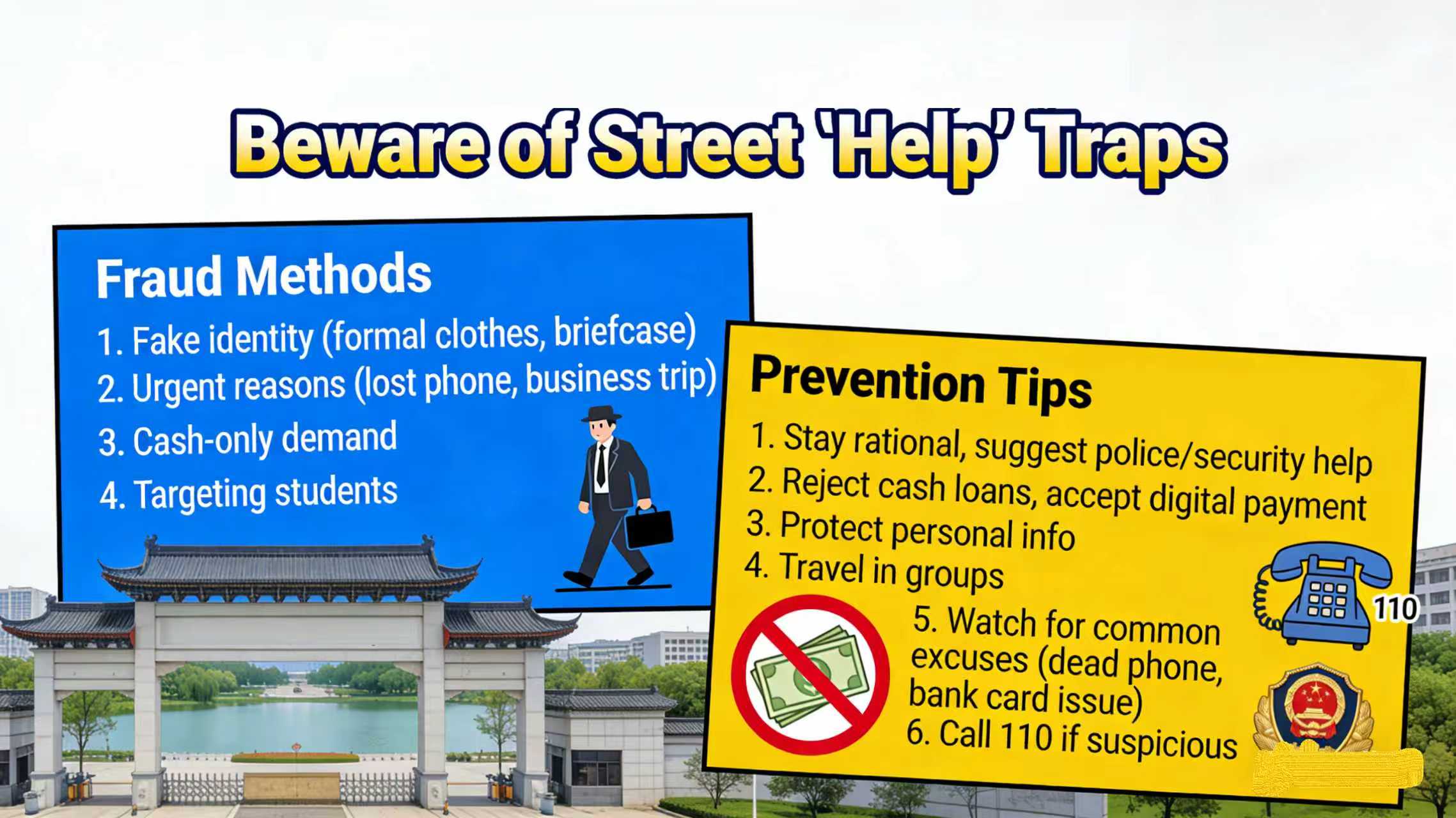
Dear international students, have you ever encountered strangers asking for help while exploring the beautiful city of Nanjing? Being helpful is a virtue, but one should also be wary of potential scams that may be hidden within it. Recently, there have been multiple fraud cases targeting students near Xianlin University City. To help international students better protect yourselves, we have compiled this anti fraud guide. Let's learn together!
I. Street "borrowing money" fraud method
In this case, the fraudster usually chose to commit fraud against students walking alone in areas with high pedestrian traffic near the university town. His operation steps are generally as follows:
1. Disguising identity, Wearing formal attire (such as a dark jacket or a hand-held briefcase), claiming to be a senior executive of a company or a business person on an urgent business trip, in order to gain trust.
2.Fabricating reasons, showing a very anxious expression on the grounds of "lost phone" and "urgent need to take a taxi to sign a contract in another city".
3.Insist on cash transactions, emphasize the need for cash to pay the toll, and refuse to use WeChat, Alipay and other electronic payment methods - this is because cash is more difficult to be tracked by the police.
4.Targeting students specifically, taking advantage of their kindness and relatively limited social experience to continuously commit fraud.
Please note: This type of fraud often exploits our sympathy and subtle barriers in language communication. Scammers may choose Chinese international students who have good English skills and appear friendly as their targets.
II. Preventive tips
1.Maintain rationality. When encountering strangers seeking help, especially when it comes to money, you can first suggest that the other party contact the police, school security, or nearby store staff.
2.Refuse cash loans. People who truly need help can generally accept electronic payments, contact friends or institutions for assistance. Persisting in borrowing only cash is often a characteristic of scammers.
3.Not easily disclosing personal information. Don't easily disclose your school, contact information, or accommodation information just because the other person looks decent.
4.Travel together to avoid isolation. Especially in unfamiliar or sparsely populated areas, try to travel with friends to minimize the possibility of becoming a target.
5.Remember common excuses. Common scams such as' phone out of battery ',' bank card not working ',' no cash on hand ', and' urgent need to go to the airport/station 'should be heard with extra caution.
6.Seek timely help and report to the police. If you feel something is wrong, you can go to a crowded place or call 110 directly to call the police. If you are accidentally deceived, be sure to keep the evidence and report it to the police immediately!
作者:邢露萍(海外教育学院) 审核:朱丹


 当前位置:
当前位置:
 首页
首页